Wednesday, May 1, 2019

The Ghost of Capablanca


by

Brin-Jonathan Butler


After a summer hustling speed chess in Vancouver to raise funds for my first visit to Havana, in 2000, I met an antique bookseller on the plane ride over who helped me find an apartment in a magical neighborhood just off the Plaza de la Revolución, where Fidel Castro still delivered speeches that occasionally ran for seven hours. A dignified 81-year-old retired doorman stood guard of the street. After moving from his job at Hotel Nacional de Cuba to the newly opened Habana Hilton, he was on duty when Castro and Che Guevara arrived in January 1959 to commandeer the top two floors for their government headquarters. I quickly made friends with all the families on the street. They took me in with more warmth and generosity than the neighborhood where I grew up. I’d been warned about the poverty in Havana; instead, these people illuminated a poverty of spirit I didn’t know I’d had back home.


I returned to Havana the first chance I could and tried to reconnect with the bookseller. He’d told me on the plane that the only thing that disappointed him about Havana was having to leave it. I found out he’d been granted his wish—cirrhosis took his life and he was laid to rest in Havana’s Colón Cemetery. When I got back to the street he’d introduced me to, everyone else had left too. The doorman had died, and the others had found various means off the island. I asked one of my few remaining friends on the block what I should do. “Resolver,” he said. Figure it out.


Artwork by Melissa Roldan


I finally found a place in a very different neighborhood: Cayo Hueso in Centro Habana. People in the street led me to a door up the road from a barber shop, caged bird store, and crushed sugarcane juice stand. I knocked and a latch swung open behind a peephole. A dark burly man with swimming-pool blue eyes unlocked the door and held it open a crack. He had as little English as I had Spanish, so instead of embarking on the usual frustrating pantomime negotiations about the room for rent, he held out two upside-down clenched fists and motioned for me to choose one. This is a ritual he’s repeated every time I’ve seen him for the last 15 years.

I pointed to his left fist, and he opened it to unveil a white knight chess piece. He smirked. “Bueno. Usted primera.” I had first move. He invited me up onto his padlocked rooftop, where his daughter brought a small mug of coffee, two shot glasses of Havana Club rum, and a scratched-up chessboard. His loyal dog, Venus, jumped into his lap and he stroked her fur, and over his shoulder was the most beautiful sunset I had ever seen. I gestured to it, and he solemnly pointed to the board before us. Chess, it was obvious, offered him a view more haunting and lovely than any sunset.

Today this gentleman—let’s call him Fernando—and his wife rent a room in their Centro Habana neighborhood on Airbnb. But many years before Airbnb was legal in Cuba and renting rooms to foreigners was subject to fines and even seizure of property, he provided for his family by secretly leasing a room on the roof of a four-story walk up.

Fernando has Chinese, Spanish, African, and German blood, and it seemed to inform all the features of his face with a noble and almost magical harmony of purpose: getting me to play one more game. On the streets below us, amidst cigar smoke and diesel fumes, the slap of dominoes was heard well into the night, while Fernando and I were invariably playing chess up above. His chessboard was always waiting on his roof, freshly reset with pieces or, more likely, frozen where a game was left off. Up there, Fernando also read from one of a dozen books reliving the games of José Raúl Capablanca, his beloved hero and Cuba’s greatest chess champion. It was Fernando who introduced me to Capablanca. I was obsessed with Bobby Fischer, but for Fernando there was only one gran maestro, not only on the chessboard, but as an artist, a scientist, a philosopher.

Fernando has a booming voice that dipped into a panicked hush for only two men: Castro and Capablanca. In all the years I’ve known him, he’s never mentioned Castro by name. Instead he motions by grabbing an imaginary beard or simply refers to “Him.” Capablanca receives the same treatment for entirely different reasons. His genius was mystical. “Capablanca,” Fernando whispered, “was born in 1888 in Havana to a Spanish army officer. That was the only ordinary thing about him.” He held the title of world champion from 1921 to 1927 and is regarded as one of the great artists of the game. “But he was bigger than the game!” Fernando assured maniacally. “The Yuma at Time magazine put him on the cover in 1925. Brinicito, do you know the other men who were on Time magazine that year? Winston Churchill! Charlie Chaplin! Leon Trotsky! John D. Rockefeller!” He lost only 35 games in his entire professional career, and upon dying in 1942—while watching a chess game at New York’s Manhattan Chess Club—his body was sent back to Havana and honored with a state funeral.

Chess had arrived in Cuba more than four centuries earlier, aboard Columbus’ Spanish ships in 1492, and while the shackles of colonialization were broken with Cuba’s revolution in 1959, chess’ hold on the island nation has proved considerably more durable. They joke in Cuba that what King Midas was to gold, Castro was to politics, but Fernando likes to remind me that chess is 1,500 years old and will be around long after communism or capitalism. “Like a great book that never finishes what it has to say, chess is no closer to being solved. It only gets more beautiful as people try in vain. Just like life off the board, we all resolver.”

Resolver—“to resolve” or, colloquially, “to get by”—remains one of the most vital words in the Cuban vocabulary. Considering the new and unknown challenges ahead for Cubans, perhaps it’s not surprising that chess has never flourished more.

The last time I’d seen Fernando was during Barack Obama’s March 2016 visit to the island, the first time a sitting American president had done so in 88 years. In November, I watched from back home in New York as the island experienced an even bigger political disruption: the death of Fidel Castro, who had inhabited the island like Moby Dick in a goldfish bowl. In January, I wrote Fernando to see if he would help me dig deeper into Cuba’s chess history. I wanted to understand its relevance to today’s culture, and how it might illuminate the tidal waves of change on the island. He wrote back and suggested we begin at the Capablanca Chess Club, the first place he went after his own father could no longer give him a decent game.

Before leaving for Cuba, I met with Bruce Pandolfini at a diner near his Manhattan home. Pandolfini is one of the most sought after—and probably the most famous—chess instructors in history. He served as the Manhattan Chess Club’s executive director from 1984 until 1987. “Capablanca was called invincible,” Pandolfini told me, wiping coffee from his mustache. “Capablanca always claimed his brilliance lay in intuition rather than calculation. It was almost supernatural.”

Stories about the genesis of Capablanca’s genius all have the same basic coordinates regardless of the storyteller, but every version blossoms with unique awe. Pandolfini told of how, at 4 years old, Capablanca was watching his father and uncle play one afternoon. His uncle went to the bathroom, and Capablanca notified his father that his uncle had cheated with his knight. (Capablanca maintained an obsession with knights all his life, and no other player has ever been more of a magician with them.) His father didn’t believe his son knew how to play and challenged him to a game. According to some, Capablanca played his father to a draw. “There are so many myths,” Pandolfini said, laughing. “They all take on a life of their own.”

Pandolfini brought along private artifacts given to him by Capablanca’s late widow, Olga: unpublished photos, a letter, Capablanca’s personal Cuban National Bank book with a lone deposit for $6,000 from his winnings on December 23, 1941. Pandolfini also showed me a prized book of Russian chess openings that a teenaged Bobby Fischer had once carried all over New York for a year. Midway through the book was Fischer’s clunky and strangely printed signature: “BOBBY” in all caps and “fischer” lowercased. In 1965, when Bobby Fischer was denied entry to Cuba for the José Raúl Capablanca Memorial (the Bay of Pigs invasion had increased tensions between Cuba and the U.S.), Fischer competed in the tournament by telex from inside the Marshall Chess Club in New York. Pandolfini relayed Fischer’s moves while José Raúl Capablanca Jr., Capablanca’s only son, did the same for Fischer’s opponent in Havana. Fischer lost, and the following year he was granted entry to Cuba and competed in several exhibitions on the island, including one against Fidel Castro. (Castro won.)

“Olga always believed in reincarnation,” Pandolfini told me while repacking the artifacts in his leather bag. Paul Morphy, the greatest player of his era, died in 1884, and Capablanca was born four years later. Olga believed Morphy’s spirit entered her husband’s body. Capablanca died in 1942, and a year and a day later, on March 9, 1943, Fischer was born. “She was certain Capablanca’s spirit went into Bobby’s genius,” Pandolfini said. “For her it was all a continuation. Fischer always adored Capablanca’s games. When he played the match on telex during the Capablanca Memorial in Havana, he played on a table Capablanca had donated to New York.”

After landing in Havana in March, a ’57 Chevy taxi takes me from the airport past the Plaza de la Revolución, where murals of Che Guevara and Camilo Cienfuegos climb several stories across a pair of buildings. All the driver can talk about is the local taxi strike. Queues of stranded commuters are gathered all along the highway, and their ranks increase as we edge closer to the heart of the city.

We swing past the gates of Colón Cemetery, where Casablanca is buried, his grave marked with a white queen chess piece. Fernando brought me to the grave after our first handful of games. Vendors sold paper funnels of peanuts outside, and Fernando bought a half-dozen for our tour. “Peanuts everywhere,” he said, tossing a handful into his mouth. “Yet peanut butter has yet to be discovered on the island.” It was one of a thousand paradoxes he navigated every day. He worked at a hospital full-time but had struggled to support his family until he began renting out the spare room in his apartment. He hated the risks, but what choice was there? He introduced me to the chess term zugzwang, a situation in which you’re forced to move but every available move puts you in a worse position. “Resolver,” he said, shrugging.


Driving into town, it’s clear that all of Havana is dealing with change. For years, Cuba’s connection to the outside world via the internet has been miserably limited and terribly expensive. Now the government sells one-hour internet cards for 2 Cuban pesos, which are snatched up by entrepreneurial locals and scalped with a 50 percent markup. Cellphones were once rare; now they are as ubiquitous in Havana as any other major city. (When the Rolling Stones played the largest concert in Cuban history just after Obama left last year, what amazed me more than the estimated 500,000 people in attendance was how the audience experienced the event: behind a phalanx of iPhones. Just like everywhere else.) Wi-Fi locations all over the city are filled with clusters of young Cubans nodding off into the glow of their phones. Of the 30 friends I made who were around my age during my first trip to the island in 2000, only five of them remain in Cuba. The rest started new lives in Miami, Spain, Austria, Canada, and elsewhere. While pawns are the most vulnerable piece on the chessboard, they are also the only piece capable of transforming into something entirely new, provided they make the perilous journey across the board.


I drop off my things and catch a cab down to the Malecón, Havana’s famous boardwalk, where Fernando is waiting to join me at the Capablanca Chess Club (just down the hill from the Hotel Tryp Habana Libre, where the first Capablanca Memorial was played in 1962). When I climb out of the cab, a wave crashes over the seawall and splashes a bicycle taxi carrying two tourists in the backseat. I greet Fernando, who’s carrying a chessboard under his arm, and he tells me he’s arranged a meeting with José Antonio Hedman, one of the professional players who works with children at the club. “Do you know where the money came from for the first Capablanca Memorial tournament?” Fernando asks.

I shrug.

“Che Guevara raised the money. Later on, he regularly played against visiting grandmasters. Even Bobby Fischer. Che’s father took him to a tournament when he was a boy growing up in Buenos Aires, and he saw Capablanca playing. That’s where he first got addicted to chess and also where he first learned about the country where Capablanca came from. Che and the Cuban government invested huge amounts of money to support the game.”

Standing before the entrance of the club, it’s clear that those investments weren’t aimed at ostentatiousness. There’s a large row of pink-framed windows nestled into a cream-colored cement exterior, the paint chipped and peeling from the salty sea breeze. Next to the front door, “CLUB CAPABLANCA” rests above a plaque commemorating the centennial of Capablanca’s birth. The club itself has been in operation for almost a century.

Inside, the mint green walls are mostly bare, save for a schedule of lessons and events and a green-and-white magnetic chessboard hung behind an office desk. Aside from the two club managers’ desks pushed up against one wall and a row of tables emblazoned with eight chessboards on the other side of the room, the club is filled only with sunlight. Somehow the place feels a bit like an abandoned church. Inspecting the green-and-white squares on the wooden boards, I slide my index finger inside the grooves worn from excessive use.

Fernando and I sit opposite Hedman, a painted board between us. “Life in Cuba,” he explains, “is about solving challenging problems. The skills chess offers help us a great deal on and off the board.”

Chess is taught in nearly all Cuban elementary and high schools, and in 2003, universities began offering chess degrees. A year later, with 13,000 players taking on 500 chess masters, Cuba broke the world record for the largest simultaneous chess exhibition in history. In 2008, Cuban grandmaster Leinier Domínguez won the World Blitz Championship. While Domínguez is a long way from rivaling Capablanca’s accomplishments, he’s hovered around the top 20 of the world’s best chess players for some time.

This didn’t happen by accident. After Castro banned professional sports in 1962, huge resources were devoted to making Cuba a global powerhouse in baseball, boxing, and chess. The symbolic value of triumph in these fields during the Cold War paid huge dividends. Cuba went on to dominate Olympic boxing and international baseball, and, for an island of only 11 million people, Cuba has so far produced an astounding 43 chess grandmasters.

Hedman invites Fernando and me to an upcoming exhibition at the Meliá Cohiba Hotel. Some of the children Hedman has worked with at the club, he tells us, are eager to glimpse their chess heroes. Domínguez might even be in attendance.

When I spot Fernando’s taxi approaching the Meliá Cohiba the morning of the exhibition, the driver is frantically trying to dodge a patchwork of sea puddles. Fernando hops out and sniffs around the hotel for the exhibition, but nothing advertises it, so he asks the security guards inside for help. They suggest we ask the front desk. No luck there either. A different security guard approaches and advises us to try the Hotel Riviera next door. Nobody at the Riviera has any clue what we’re talking about, so we’re back to square one in the lobby of the Meliá Cohiba. “Cuba neo,” Fernando moans. Only in Cuba. Just then Hedman taps me on the shoulder.

“You made it,” he says, smiling. “There is good news and bad news I have for you. Domínguez will not be here this morning. However, one of our best gran maestros will be here, Lázaro Bruzón.”

A crowd of equal parts children and adults gathers around the restaurant next to the hotel entrance, and at 8:30 a.m., we’re let inside a surreal room furnished with jukeboxes, 1950s American convertibles, and aging Cessna planes. Dozens of tables surround a stage with a screen hanging over a main chess table—the centerpiece on display.

Hedman approaches with Bruzón, still boyish at 34, at his side. After shaking hands, Bruzón explains he learned chess from a neighbor when he was 7. By 9, he’d devoted his life to the game, and the Cuban government recognized a prodigy in its midst. At 18, he won the World Junior Chess Championship, but now, 16 years later, he explains that he is cutting back on international tournaments. He’s receding from a life perpetually in the orbit of chess, a confession that is accompanied by a mix of mournfulness and relief. “I am immensely proud to have represented my country around the world,” he tells me.

There’s an ease about Bruzón’s demeanor that leaves an impression on me. It’s a stark contrast to the lingering tension and friction felt by elite Cuban athletes in other sports. “Have any of the top Cuban chess players left the island?” I ask Fernando after Bruzón excuses himself.

“None that I know of,” he says. “Chess players who devote their lives to chess probably live much more comfortably here than they would in a different system.”

Which makes sense. I’ve interviewed some of Cuba’s finest boxers and baseball players. In many cases, they’ve rejected the vast fortunes that come with leaving the island and crossing 90 miles to compete in the U.S. While none openly regret their decision, they lead lives much like double-exposed photographs, always wondering how they would have fared if they had left. Over the last 10 years, Cuban baseball and boxing have been gutted by international poaching. But not chess. On top of having their needs looked after, chess players in Cuba are seen as something between an athlete and an artist. They might be more appreciated and respected here than anywhere else.

After turning the matter over, Fernando puts his hand on my shoulder. “We admire la lucha [“the struggle”] as much on the chessboard as we do in the boxing ring. Our lives here have always been a struggle, and approaching that struggle with the courage of a boxer or the cunning and intelligence of a chess player is something that commands our respect. The same rules apply in a boxing ring or on the chessboard or growing up in our crazy system: resolver. Many places around the world are confronted with the same thing. They just don’t have our sense of style.”

After the exhibition concludes, kids still hunched over chess tables, Fernando tucks his chessboard under his arm and suggests we go to Cojímar, 10 miles east of Havana, where he grew up and first learned to play. We catch a taxi on the Malecón and head toward the lighthouse. Just before we plunge into the shadowy-yellow glow inside the eastbound tunnel out of Havana, I watch as fishermen cast their lines toward Miami and a gigantic cruise ship enters the harbor.


When we emerge on the other side, very little civilization remains. We close in on a spooky unguarded tollbooth, beyond it only palm trees and giant street lights outstretched like a diver’s arms before takeoff. We pass a stagnant-looking stadium built for the Pan American Games 25 years ago, a paint-chipped mural of Che staring out from inside of what looks like the upside-down ribcage of Jonah’s whale. Soon after, Fernando taps the driver’s shoulder from the backseat and we walk the rest of the way into his village.

As we wind through the outskirts of Cojímar, the sea comes into view and we spot the long wooden pier that was once home to Ernest Hemingway’s boat, Pilar. Near the pier is the Torreón de Cojímar, a battered fort built in 1649 to protect Havana.

A bus of tourists pulls in to visit La Terraza, Hemingway’s favorite local restaurant, but Fernando’s spot is a laid-back rooftop restaurant on a nearby backstreet, perched above a Dalí-like set of stairs. When we arrive, a local boy is posted in front of the stairs, holding a varnished wooden object the size of a sunglasses case. He holds out the box and asks in English if I’ve ever seen a “romance box” before. I shake my head, and he smirks and seamlessly pulls it apart, holding out both halves of the box with his arms spread wide. He brings the pieces back together and effortlessly repeats the gesture once more. “I’ll give you 30 seconds with it,” he tells me. “If you can open the box, it’s yours to give to the one you love. If you cannot open it, then you must pay me 10 pesos to keep it.” He quickly opens and shuts the box again with a blurring sleight of hand. “See how easy it is?”

I glance over at Fernando, but he’s too busy staring at the boy to offer any counsel. So, gullibly yet determinedly, I play the sucker. “¡Vamos!” he says, staring at his watch. I feverishly work the thing over like a Rubik’s Cube until the boy hollers, “¡Tiempo! Diez pesos por favor.” I absentmindedly hand the box to Fernando and fish my pockets for the boy’s fee. When I fork it over, the boy is no longer paying attention to me. He’s staring at Fernando, who is calmly repeating the boy’s opening and closing demonstration.

“How?” I gasp.

“I had the same job here when I was his age,” Fernando says. “But”—and he suddenly switches over to Spanish—“when I saw a girl I loved at first sight, I asked her for something more if she couldn’t solve the romance box in 30 seconds.”

“What?” I ask.

“I asked her to go on a date with me. But first I wrote a secret message and put it inside the box. When she couldn’t open the box, we went on our first date and I gave her the box as a gift.”

“What did you write in the note?” the boy asks. His swagger has left him.

“I asked her to marry me.” He laughs and passes me the box, freeing up his hands to dig through his pockets for a black and a white chess piece. He holds them in his clenched fists and motions for me to tap one, but the boy interrupts.

“What happened to the girl?” he implores.

Fernando ignores the question and grunts for me to choose a fist. I do, and Fernando holds out a white queen in his palm.

“Did you ever see the girl again?” the boy asks deliriously.

“Of course I did. I saw her this morning, when I cooked breakfast for her and our daughter.” Fernando turns and winks at me. “Resolver.” 


Credits:  This article originally appeared in 2017 in Southwest: The Magazine.


Thursday, February 28, 2019

Did Ralph Ellison Leave a 2d Classic?

by
William Grimes


In a pivotal scene, members of the congregation make a trip to the Capitol to warn Senator Sunraider that his life is in danger. After being turned away from his office by his secretary, the group goes to a visitor's gallery just in time to see a young man rise and shoot the Senator.

Theories abound to explain the inordinately long writing period for this second work of fiction. Mr. Ellison's friends say he was not struggling with writer's block, but there is no doubt the achievement of "Invisible Man" pitched his own expectations very high.


"As an artist I think he came to sense the magnitude of 'Invisible Man' as what Bellow called a victory," said Mr. Callahan. "That made him set his standards higher."

Mr. Ellison's friends also point out that the fire that destroyed his manuscript devastated the writer. It was five or six years before he could bring himself to reconstruct what had been lost. And when he did, his thinking about the work had changed.

By all accounts, the novel that slowly took shape after 1966 was quite different. "It changed, I know that," said Mr. Fox. "It became longer. The second version, I gather, is a much more ambitious book than the one destroyed in the fire."

In an interview in 1981, Mr. Ellison said: "The new book's form is a realism extended beyond realism. It's a crazy book, and I won't pretend to understand what it's about."

As a practical matter, the enormous success of "Invisible Man" made its author a public figure, as well as freeing him from the financial need to publish.

"Part of the problem was that his first novel received the National Book Award, and he then began receiving awards and degrees," said Robert J. O'Meally, a professor of English at Columbia University who has written two books on Mr. Ellison. "His standards were high already. And the pressure then was more than he could bear to equal what he had done before."

Mr. Ellison deeply admired Andre Malraux, who combined the roles of novelist, public intellectual and government official. He took great pride in serving on the Carnegie Commission on Educational Television, which established public broadcasting in the late 1960's, and he served on the committee that created the John F. Kennedy Center for the Performing Arts in Washington.

"All this gave him certain opportunity to be a public man and a citizen," said Mr. Callahan, "but some of those responsibilities he might have wished would pass away." Work on the Transitions

Ellison scholars often argue, in a somewhat aggrieved tone, that his two works of nonfiction would entitle him to a prominent place in American letters even if "Invisible Man" had never been written.

In recent years, however, Mr. Ellison seemed to be within striking distance of another complete novel. His working method was to construct vignettes or long set pieces, which he then wove together. In his introduction to the 30th-anniversary edition of "Invisible Man," he stated that it took seven years to write in large part because of the attention he lavished on the transitions binding the main sections of the work together. The same painstaking work, apparently, occupied his last days. Painstaking, but far from painful.

"I spoke with him on the phone on March 12, and he was as expansive and outgoing as could be," said Mr. Callahan. "He spoke of the day's work he had just done on the novel."

Apparently, Mr. Ellison liked what he saw. And for a man supposedly wrestling with the muse, he seemed to be laughing a lot. "Fanny would say she'd come upon him at work and he'd just be chuckling," said Mr. Callahan. "He was having a hell of a good time."


Credits:  This article was originally published in The New York Times in 1994.

Thursday, January 17, 2019

Julio Cortazar Visits New York in the '70s.

by
Frank MacShane


JULIO CORTAZAR, the Argentine novelist, was in New York to consult his publisher about his forthcoming book. “It's called ‘Libro de Manuel’ in Spanish,” he explained in a conversation. “We had some trouble with the English title.


'Manuel's Book’ seemed a bit dull, so Gregory Rabassa, who is my translator and loves to play with words, suggested ‘Manuel's Manual.’ But that seemed rather a mouthful, so it's going to be called ‘A Manual for Manuel.’"

Asked whether it was in any way like his famous novel, 'Hopscotch,' he replied that it is also placed Paris and that the characters are Argentine. “But whereas in ‘Hopscotch’ I was mainly interested in the inner lives and relationships of the characters, in this new book I am concerned with the effect of public events on them. That's the difference between now and then. Inevitably we have become politicized. The novel is about a group'of young revolutionaries, and is full of kidnappings torture-- all the things we read about every day in the newspapers.

“Naturally I did not want to make it a political tract — it is, after all, a piece of fiction — so I had to try establish an equilibrium between the private lives the characters and public events. I have tried to deal with what happens in the novel with some humor and to use comedy. Also, I have actual documents — headlines and articles from French newspapers, from the Paris Herald‐Tribune, and from Argentine newspapers as well, for the book takes place in 1971, when Lanusse was President of Argentina and the use of torture for political reasons became a common practice. While I was writing the novel, I was myself reading these headlines and articles, so I had my characters read them well.”

Mr. Cortazar noted that it was important to separate political opinions and beliefs from fiction. “When I write a novel,” he said, “I am writing directly from inside, myself. I am trying to express what I see and what I feel about the world around me. That is why have tried to set up the equilibrium between humor and documentation in the new book. At the same time I am a political person. I have actively tried to carry out my belief in the future of socialism the world without belonging to a political party because I believe it is better for a writer to be independent. It is my duty as a man to be politically active, but I don't think you should allow this to influence your writing. Let me tell you a story to illustrate what I mean: On one of my trips to Cuba 10 years ago met some guerrieros. I didn't really meet them because the room was kept so dark I could only see their hands. But they told me that when they were in the jungles of Venezuela, when they were trying to recover from their exhaustion, they liked to read from my book, ‘Cronopios y Famas.’ They didn't read Lenin or Marx: they read these stories, which are mainly fantasies. I was very moved when they told me that it was the same with Che Guevara: he didn't carry ‘Das Kapital’ in his pocket. He had a copy of Neruda's ‘Canto General’ with him.

Mention of his short stories prompted Mr. Cortazar to comment on the difference between writing long and short fiction. “For me,” he said, “a novel is a long process or development, dealing with a number of subjects that evolve along the way. For instance, Manual for Manuel’ has a lot to do with sex in Latin America. I try to go into that subject as far as I can; machismo and with notions of male superiority. This on top of the other things the book is about. So, a novel is a rich experience, something that opens as many issues and lets them unfold. A short story is very different. I think of it as a kind of glass sphere in which you try to enclose a few perceptions, a few feelings. It must be complete within itself and brief enough to have a tight form. Sometimes when I am writing a novel I think of something that doesn't belong there but has a life of its own. So I stop and make a short story of it if I can. A short story is more like a poem than like novel.”

Speaking of the so‐called “boom”—the literary explosion from Latin America that some people contend is an artificial phenomenon created by publishers—Mr. Cortazar pointed out the irony that it should be known by an English word. “No, I don't think it's artificial at all,” he said. “Let me tell you that when my novel 'The Winners’ was first published in this country, I was accused of writing an imitation of Katherine Anne Porter's ‘Ship of Fools,’ but the reviewers didn't bother to notice that in Spanish the book came out two years before Miss Porter's novel. The point is we were thought to be imitators—either that, or we had to write books full of local color, with señoritas 
and gauchos and tangos. In Latin America it was the same. Twenty years ago, our readers were only interested in the latest Faulkner or Steinbeck or Mauriac. Latin American literature was considered to be utterly inferior.

“What happened then was that a group of writers ‐Miguel Angel Asturias, Alejo Carpentier, Gabriel Garcia Marquez, Carlos Fuentes, Mario Vargas Llosa, myself and some others began to write novels that allowed Latin Americans to realize that within their own heritage there was material as rich as any in the world. It began to be recognized that we could write about all sorts of things without being accused of being imitators. We turned inward to try to discover the roots of our own being, and when we did that we ended literary colonialism in South America. Above all, we gained the confidence of our readers, and that is what the ‘boom’ is all about.”

On his return to Paris, Mr. Cortazar hopes to finish up a series of short pieces—some only a page long—which are about incidents, places, people. They number more than a hundred. He is also waiting for the translation into English of two books of short stories. One of these has only recently been published, but not in his native Argentina, because he refused to allow it to appear with two of the stories omitted for fear of censorship.

Asked whether he was part of the literary life of Paris, he answered: “No, I am not. Of course I know the French writers, but mainly through their books. I really don't like being with writers as much as with painters and musicians. I was a friend of Pablo Neruda's when he was ambassador to France, and I see other Latin American writers when they come through. But the intellectual life of Paris is too professional for me. There are always panel discussions and meetings, which I don't like. Anyhow, I don't think in abstract terms nor do I make generalizations: I see things and feel them. And music is very important to me.”

Credits:  This article was originally published under the title 'Visit from Julio Cortazar' in 1978 in The New York Times.  It has been edited slightly for the sake of clarity.


Monday, January 7, 2019

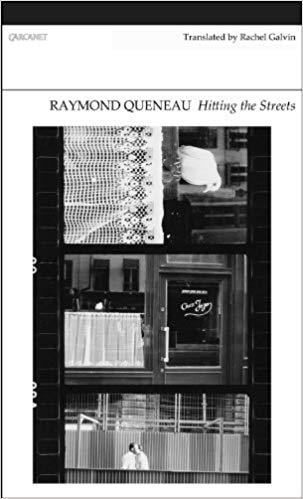
Hitting the Streets by Raymond Queneau – review

By
Nicholas Lezard

You have to love an Oulipian. These were, or are, the writers who, as Queneau himself put it, are rats who build the labyrinths they try to escape from. You know, writing entire novels without the letter E, or telling the same very banal story (about a young man in a silly hat getting jostled on the bus and then being seen in a park a couple of hours later; really, it is banal) in 99 different ways, many of them absurd (and very funny). That latter wheeze, Exercises in Style, was Queneau's; and he co-founded the movement – whose name is short for "Ouvroir de littérature potentielle", or "potential literature workshop" – when he asked a mathematician for help in composing his work Cent mille milliards de poèmes. This involved each line of 10 different sonnets being printed on its own strip of paper, so that one hundred million million poems, give or take a million or so, can be constructed by the reader.

No such japes in this volume of poems, though – just an enormous number of headaches for the translator. But it is fun for the reader. In one of his poems, just four lines long, Queneau sets a number of traps, punning on, to take one example, different meanings of "fils" (son, or wires, take your pick), and ends with the challenge: "allez me traduire ça en anglais!" Which Rachel Galvin, naturally enough, renders as "go translate that into French for me!"


It's the spirit you have to get into above all here, and Galvin knows it. As she points out in her excellent introduction, Queneau's most famous work (and the one that released him from half a century of financial anxieties), Zazie dans le métro, begins with the word "Doukipudonktan". Fancy a stab at that? She also coins, in an attempt to translate the portmanteau word "fientaisie", the fantastic word "whimsicrap", which I have a feeling is going to come in very handy for us all.

So it is as well that this book comes with the French, too. Queneau was one of those writers who knew pretty much everything there was to know about literature, but he also loved word games, and the language of the streets. These combined to produce this book, which contains about 150 poems, almost every one of which is a love letter to Paris. Though maybe "love letter" isn't the right phrase to describe "Un beau siècle" ("One Fine century"), which goes "Conneries des années 1900 / Connerie de la belle époque" ("stupidity of the 1900s..." etc) all the way through to the year 2000, even though the book itself dates from 1967. ("Conneries" is rather stronger than "stupidity", but we don't have a word for it.)

But the thing I most want to impress upon you is that just about every single one of these poems is a delight – the kind you want to show to people. There is a very impish, almost mischievous sense of humour at work here; you get the impression that Queneau would have been a delight to meet and get to know. I'm thinking of "There was a Waterloo Passage / it's been demolished / it's just that we're patriots in Paris", or "Advice for Tourists", which lists, as attractions near the Boulevard Sébastopol, the Acropolis, Whitechapel, the Kremlin, the Pentagon … I could go on and on.)


Galvin quotes another Oulipian as saying "since Baudelaire, poetry has explicitly loved the big city", and Hitting the Streets is an extension of that project – especially as incarnated by the work of Apollinaire, who also made extremely witty and readable poetry out of avant-garde forms. Paris seems particularly suited to this kind of project; and Queneau is particularly good at it. The city becomes anthropomorphised, or at least given a vibrant and inimitable character; even its flies are, if that is the word, celebrated ("The flies of today / are no longer the flies of yore / they are less cheerful"). You might balk at the idea of paying nearly thirteen quid for 197 pages of poems, and French poems at that, but I promise you you'll love this. Especially if you love Paris.

(This article was amended on 5 August 2013 to correct misspellings in "Cent mille milliards de poèmes" and "Doukipudonktan.")

Credits:  This article appeared in 2013 in the US edition of The Guardian.


Wednesday, December 26, 2018

Leonora Carrington: "England's last living Surrealist"

by
Rachel Rickard Straus and Ruth McClean

In the biggest metropolis in the Western world, amid drug wars, earthquakes and swine flu, 92-year-old Leonora Carrington opens the biscuit tin resting on her oilskin Liberty tablecloth. "Do you want more tea?" England's last living Surrealist asks politely. Bronze statues, child-size casts of Carrington's frighteningly powerful imagination, lurk throughout her Mexico City townhouse. A masked pig peers out from under a hat stand. Something half human skulks under the stairs. But Carrington is unfazed by monsters; she has been conjuring them all her life.


Leonora Carrington
The Unicorns and the Ghost in the Wall

Carrington is a painter, writer, sculptor, alchemist, visionary, and was the darling of the 1930s Surrealism movement. Now, after decades of absence from the English art scene, her work was presented at Angels of Anarchy, a major exhibition of women Surrealists at the Manchester Art Gallery next month.

Throughout a seven-decade career of prolific creation, the same images have appeared in Carrington's art again and again. Ghosts turn into crows, pigs unfurl wings, armchairs produce arms and women grow birds as limbs. No one knows, and Carrington refuses to reveal, where her ideas come from and what she means by them.

Naturally, legions of art historians have tried to work it out. The art collector Edward James, her friend and patron, thought he'd solved it when he said that, "The paintings of Leonora Carrington are not merely painted. They are brewed. They sometimes seem to have materialised in a cauldron at the stroke of midnight."

Wise, mad and contrary, Carrington has lived a life every bit as surreal as her art. This is a woman who wouldn't think twice about serving you an omelette made with your own hair. Sixty-nine years ago, the 23-year-old Carrington, already a notorious avant-garde artist, and the lover of the 46-year-old Max Ernst, escaped from a Spanish lunatic asylum. Terrified of the Nazis and half mad, she hastily married a Mexican poet, got on a boat and fled Europe forever. Since then, she has spent nearly all her time here, in the same three-storey house in a leafy, run-down artists' area of Mexico City. The branches of the tree she planted long ago at the centre of her house, now almost tap on the windows of her old rooftop studio.

Today, her smile is still so bewitching you can see how she mesmerised Max Ernst 70 years ago. Her hair is pinned up in the same way it was on the day of her wedding and – although it is 30 degrees outside – she is dressed in elegant woollens. "I miss England," she says, sipping her Earl Grey tea. "Although I probably just miss the past." When Carrington left England in 1937, Surrealism was considered shocking, and three kings had sat on the throne in the space of a year. "Who have we got now?" asks Carrington. "Elizabeth? She must be quite new."

Carrington was born during George V's reign, to Harold Carrington, a textile tycoon, and Mairi Moorhead, who filled her with Irish folklore. They were social climbers and, much to the young Carrington's disgust, took great delight in having her presented at court. "We were taught to walk like this," says Carrington, walking her slender fingers sideways across the tablecloth. "All I could think about was how much my tiara hurt."

Carrington drew and painted from a very early age. "My parents didn't mind me painting. I suppose they thought it kept me off the streets," she says roguishly. Unfortunately for her parents, the painting they had encouraged became more than just a harmless amusement. When she was just 19, they lost their daughter to it.

While studying art in London, Carrington met Max Ernst at a dinner party. Ernst was 46, on his second marriage, and one of the best known artists in the world. Enthralled, Carrington defied her furious parents and, leaving everything she knew, took off with him. The couple moved to Paris and straight to the heart of the Surrealist circle which included Man Ray, Paul Eluard, Marcel Duchamp, Joan Miró, and was led by André Breton, whom Carrington describes as ' "the headmaster of Surrealism". She remembers: "There weren't many parties, but we used to meet at cafés and discuss everything."

Carrington took advantage of whatever parties there were. She turned up naked to one and painted the soles of her feet with English mustard at another. She famously served guests hair omelettes at a dinner party, using locks she had lopped off their sleeping heads the night before. She never tried to be a Surrealist, but her paintings of fantastical creatures and living furniture happened to encapsulate the essence of the movement. "I didn't think of myself as a Surrealist. I try not to think of myself as anything. We all have these egos, you know," she explains.


The Parisian parties came to an end when Ernst and Carrington were driven out of the city by Ernst's angry wife, Marie-Berthe Aurenche. The lovers eloped to Saint Martin D'Ardeche, a tiny village in the south of France, where Carrington bought a small farmhouse. "Ah, Provence," she says. "I was very happy there. I worked, I painted, I had a vine I looked after."

They led a peaceful life, except for the occasional invasion by Surrealist friends from Paris. Ernst and Carrington painted each other, worked together, and created alter-egos for themselves. Ernst's Loplops and Carrington's Bride of the Wind still occupy the old farmhouse, as huge reliefs that Ernst sculpted against the front wall.

Their creative bliss ended when Ernst was taken to an internment camp by the Nazis. Carrington was left alone for many months, only occasionally being allowed to take paints and brushes to the incarcerated Ernst. Not knowing whether he would live or die, she stopped eating. She drank orange-blossom water to induce vomiting, hoping her sorrow would be alleviated by the spasms.

She was eventually rescued by Parisian friends who were fleeing France in their small Fiat. Carrington sold her house to a neighbour for a few francs, set her pet eagle free, and drove to Madrid. "I had to leave Europe because of Hitler. The Nazis didn't like the Surrealists at all," she says.

She later wrote with unflinching honesty about the corpses she saw on the road to Madrid, about being gang raped by soldiers when she reached the city, and about her escalating madness.

"In the political confusion and the torrid heat, I convinced myself that Madrid was the world's stomach and that I had been chosen for the task of restoring this digestive organ to health," she wrote in her diary. After articulating some of this to police at the British embassy, Carrington was thrown into a mental asylum where she was dosed with the seizure-inducing drug Cardiazol and left for days strapped to a bed, naked and convulsing.

Word of her condition got to England and Carrington's parents ordered her nanny to go – by submarine – to collect her. But she had no intention of going back home. She crept out of a bathroom window and escaped; hailed a taxi, and, in desperation, made a decision which changed the course of her life. "Take me to the Mexican embassy," she ordered.

There she found Renato Leduc, a Mexican poet and friend of Picasso, whom she had met once or twice in Paris. He took pity on her, and they married so that she could get a Mexican visa. They tried out married life together for a year in New York and Mexico City.

"But Renato was impossible to live with," announces Carrington, drawing at her cigarette. "He kept going off for days and not telling me where he was. So I did too, until I met someone else."

That someone else was Emerico Weisz, a Hungarian Jew and press photographer, whom she later married and had two sons with. She also found new artist friends, Remedios Varo and Kati Horna. The three, once described by Frida Kahlo as "those European bitches", became very close, and their children grew up together.

All the while, high up in her studio, she continued to paint. The same creatures she had painted in France, those from fairytales and Irish folklore, continued to appear under her paintbrush, joined by the ghosts, Mayan folklore and pyramids of her new home. Elements of Celtic mythology, Tibetan Buddhism, the Kabbalah and the occult were also thrown into her cauldron.

In the 1950s, Carrington began her only novel, The Hearing Trumpet. This April, she turned the same age as the book's 92-year-old heroine, the bearded and slightly senile Marian Leatherby. Their antics and utterly convincing nonsensical views on life are strangely similar, as if Carrington always knew what she would become. She continues to live half in and half out of the world. "I've lost my sense of time and space," she says, not with displeasure. "Not so much space as time. I remember strange things."

She is always curious about what's going on outside her walls. She reads newspapers and applies her common-nonsense to politics: "It is impossible to understand how millions and millions of people all obey a sickly collection of gentlemen that call themselves 'Government'." She eats out every week, and regularly attends gallery openings, although she is unconvinced by abstract art: "Yeugh. It seems to always be getting bigger. I like small things."

As Carrington helps herself to another biscuit, preparations are under way on the other side of the ocean to heighten her profile. In addition to the Manchester exhibition, Pallant House Gallery in Chichester is preparing for an exhibition next year of work by Carrington, Varo and Horna. She is quite unconcerned by all the fuss. "Why would anyone be interested in me? I'm just an old lady."

Despite possessing one of the world's most potent imaginations, being an inspiration to generations of artists and treasured as the last link to the Surrealist movement, she remains unselfconsciously humble. "Everyone's had an interesting life," she says. "Unless they're interested in business or something."


Credits:  This article was originally published under the title "Nazis, nannies and hair omelettes: Leonora Carrington, the last living Surrealist, looks back on her extraordinary life and times" in a 2009 issue of Independent.  It has been edited slightly for clarity.


Monday, December 17, 2018

Literature in Ladino Gets Another Life

By
Henry Raymont


Sinagoga del Tránsito, Toledo Spain


Recent discoveries of texts from the Judeo‐Spanish vernacular known as Ladino— some of which had been lost for almost four centuries—are being made available in English for the first time.

Ladino, the language of Sephardic Jewry, is becoming extinct, like Yiddish. Ladino is spoken today by under half a million people, of whom 200,000 live in Israel.

In an introduction to “The Sephardic Tradition,” a book of English translations of Ladino poetry and folklore from the 16th and 17th centuries, Moshe Lazar, the editor, says the work was rushed into print “as a tribute and a memorial to Spanish Sephardic literature on the eve of its disappearance.

The 222‐page volume will be published Jan. 14 by W. W. Nbrion under the sponsorship of the Commission on Adult Education of B'nai B'rith. The book has been adopted as part of the UNESCO Collection of Representative Works, a series devoted to translations of rare languages.

To salvage the Ladino heritage, scholars have been searching for manuscripts in libraries in many countries, among them Spain, Italy and Israel, as well as taping poems and proverbs recited by elderly Sephardic Jews, mostly in Israel and Latin America.

As a result of the research, the book publishes for the first time the full 303 stanzas of the Poema de Yocef, a poetic adaptation of the story of Joseph, dating hack to the first half of the 15th century. It was written in Spanish with Hebrew letters. The poem, which the scholar found in the Vatican Library, had previously been known from a manuscript at Cambridge University with only 30 stanzas. That was published in 1930 by the Spanish philologist Gonzalez Llubcra.

The first and last stanzas of the new version, translated by Professor Lazar and David Herman, follow:

Of him our Holy Scriptures the following relate

In words of witnesses who were so fortunate.

That they saw his face so gentle and stature so great.

For in truth a giant was he and his name was Joseph.

When Israel came out of her great captivity.

A coffin was made Joseph for to carry.

And in Shekem they did bury him.

Where once in that place they had sold Joseph.

Ladino, known over the centuries under such names as Romance, Judezmo and Spaniolit, is a mixture of Spanish, Portuguese, Hebrew, Arabic and other dialects Spanish Jews accumlated in their dispersal after their expulsion from the Spanish peninsula in 1492

Proverbs, transliterated from Hebrew into Latin script (the Hebrew words are italicized) that are also reproduced in the book.

Professor Lazar, who was in New York recently on a lecture tour, said in an interview that the proverbs dated from the secular period of Sephardic literature beginning in the 15th century and reflected the satire and humor of the Spanish tradition as well as some biblical material.


After the dispersion of the Spanish Jews in the 16th and 17th centuries, he said, their folklore would incorporate songs and poems about their Christian neighbors and such themes as war, priests and adulterous wives.

Professor Lazar, who has just resigned as Chairman of the Romance Language Department of Hebrew University at Jerusalem to head the Fine Arts faculty at the University of Tel Aviv, noted that the oral tradition—where one generation treasure: Their memory, for they stemmed from the repression of the Jews’ faith by the Inquisition.

Professor Lazar declared: “When the Jews were forced to flee they kept only one treasure: their memory, for they had neither their bibles nor their books.”


Credits:  This article was first published in 1971.  It can be found The New York Time Archives. It has been edited slightly for clarity.

Wednesday, December 5, 2018

No Way Madame Bovary


By
Clive James


The first thing to say about Madame Bovary is that it's a terrific story. Other comparably great and famous novels aren't, but it is. Everyone should read it. Everyone would read it, given a free taste. The plot fairly belts along from the first page. Young Charles Bovary clumps into school to be laughed at by the other kids for his awkwardness. In no time he is a medical student, and then a doctor. The beautiful Emma Rouault is his second wife. He wins the right to her hand after setting her father's broken leg. It's a simple job but it gets him a reputation for competence. Fatally, he believes this too. Stuck with him in the depths of nowhere, Emma gradually realizes that she has married a chump. Longing for excitement and a classier way of life, she falls for a charming poseur called Leon. Their incipient affair is a standoff. But with an upmarket louse called Rodolphe she finds sexual fulfillment and plans a future. Sharing no such plans, Rodolphe dumps her. She collapses. Nursed back to health by the unsuspecting Charles, she hooks up again with Leon. This time it really happens. But the extravagance of her double life, financed by money stolen from Charles, gets her into ruinous debt. The loan shark closes in, Leon backs out, and Emma has only one way to go. On a shelf in the pharmacist's shop nearby is a bottle of … but I won't say how it comes out, because some of you might not yet have read the book.


Madame Bovary by Gustave Flaubert
Image source: Karen Kao


Some purists would say you can't. They would say that Flaubert's prose style is the essence of his art, and too near perfection to survive being translated. But we have to ask ourselves what we mean by the word "style." Undoubtedly there is a rhythm and a cadence to Flaubert's prose that only a fluent reader of French can appreciate, although the fluent reader of French had better be French. We are always better judges of tone in our first language than in a second or third. To turn things around for a moment, late-nineteenth-century French critics were under the impression that Edgar Allan Poe was not only a spellbinding tale-teller but also a great master of English prose; and in the twentieth century it was widely assumed in the French literary world that the leading stylist of the English literary world was Charles Morgan, a dim bulb now long extinguished. If we are learning a foreign language, we tend to admire writers in it who are easy to read. One of the early bonuses attached to learning Russian, for example, is that all the standard European fairy tales were rewritten from the ground up by great writers. So within a few weeks you are reading Tolstoy, whose name is on the title page of The Three Bears. It isn't all that long a step to reading Anna Karenina, because Tolstoy's sentences are never very tricky, however high the level of exposition. The temptation is to call Tolstoy a stylist. But in Russian, Turgenev was the stylist. Turgenev was the one who cared about repeating a word too soon. Tolstoy hardly cared at all.

It can safely be assumed that Flaubert's prose makes music. More important, however, is that it would be impressive even if it didn't. This is where the second, and richer, meaning of the word "style" comes in. You need only rudimentary French to spot that Flaubert never wastes a word. Every word is to the point, especially in the descriptive passages. In his landscapes trees are sometimes just trees and leaves leaves; but when it matters, he can give everything a specific name. Within four walls he gives every object a pinpoint particularity. If he is looking at things through Emma's eyes, he adds his analytical power to her naive hunger. Emma's wishes may have been blurred by her addiction to sentimental novels, but her creator, never sentimental for a second, keeps her perceptions sharp. Early in the story there is a ball at a grand house—an episode that awakes in Emma a dangerous taste for the high life. In a few paragraphs, using Emma's vision as a camera, Flaubert captures the sumptuous glamour with a photographic scope that makes us think of those lavish get-togethers in War and Peace, in Proust, or in The Leopard. Dickens could lay out a scene like that too, but he would spend thousands of words on it.

Minting his every phrase afresh, Flaubert avoided clichés like poison. "Avoid like poison" is a cliché, and one that Flaubert would either not have used if he had been composing in English or have flagged with italics to show that he knew it came ready-made. Martin Amis's War Against Cliché is nothing beside that of Flaubert, who waged his with nuclear weapons. (He died waging it: his last book, Bouvard et Pecuchet, was about no other subject.) Any translator must be unusually alert to what is alive or dead about his own use of language or else he will do an injury to Flaubert's style far more serious than merely failing to reproduce its pulse and lilt. When Flaubert seems to be saying that Charles's off-putting first wife is long in the tooth, the translator had better be careful about calling her long in the tooth, which in English means "old": Flaubert is just saying that her teeth are long. Unfortunately, evidence continues to accumulate that we are now past the time when more than a few jobbing writers knew how to keep an eye on their own prose. In the second-to-last stage of our language's decay it was enough to write correctly in order to gain a reputation for writing well. Now we are in the last stage, when almost nobody knows what it means to write correctly. Among ordinary pens for hire it is no longer common to write without solecisms; even those who can are likely to bolt phrases together with no real attention to their derivation; and in too many cases the language is utterly emptied of the history that brought it into being. This is a very depleted gene pool in which to go fishing for a translator of any foreign writer at all, let alone Flaubert. One can only salute the boldness of a publishing house still willing to give it a try. It might be wise, however, not to let the salute progress far above the shoulder until we have made sure that what we are acknowledging is a real contribution.

It may only look like one. Perhaps to mark the fact that one of the supreme achievements of French literature is being once again done into English, Oxford's physically handsome new translation of Madame Bovary, by Margaret Mauldon, bears on its cover James Tissot's Young Woman in a Boat, dating from 1870. Tissot, after quitting France the next year, spent the rest of his life being claimed by the English as one of their painters, so the invocation of his name can be counted as a nice cross-Channel touch. But Madame Bovary was first published in 1857. Considering that women's fashions scarcely stayed frozen in those thirteen years, a pedant might wish that a French painter of a slightly earlier period could have been called in; but the young lady certainly has a sensual mouth, which can be said to fit. Already, though, it is hard to suppress a suspicion that in the matter of historical fidelity things are out of kilter, and the suspicion intensifies once the book is opened. Professor Malcolm Bowie, who wrote the informative introduction, makes much ado in his back-of-the-jacket blurb about Flaubert's precision, which the professor assures us is matched by Mauldon's brand-new and meticulously accurate translation of the actual work. Any reader wishing to believe this is advised to start on page one. He had better not open the book accidentally at page 178, on which we find Emma's lover Rodolphe justifying to himself his decision to ditch her. Rodolphe is supposed to be a creep, but surely he never spoke the French equivalent of late-twentieth-century American slang: "And anyway there's all those problems, all that expense, as well. Oh, no! No way! It would have been too stupid."

Just to be certain that Rodolphe never spoke like a Hollywood agent, we can take a look at the same line in the original: "Et, d'ailleurs, les embarras, la dépense … Ah! non, non, mille fois non! Cela eût été trop bête!" The perfectly ordinary, time-tested English idiom "No, no, a thousand times no!" would have fitted exactly. The awful possibility arises that Mauldon has never paid much attention to English idioms like that. Instead she thinks "No way!" is perfectly ordinary. We can take it for granted that she knows the French language of Flaubert's era inside out. (She has already translated, for the same series of Oxford World's Classics, works by Zola, Stendhal, Huysmans, Constant, and Maupassant.) But she has a crucially weaker knowledge of how the English language of her own era has been corrupted. You might say that English has always advanced through corruption, but "No way!" is an idiom so closely tied to the present that it can hardly fail to weaken any attempt to summon up the past. In Alan Russell's translation of Madame Bovary, first published by Penguin in 1950, there is no "No way!" Probably the phrase did not yet exist, but almost certainly Russell would not have used it even if it had. What he wrote was "No, no, by Heaven no!" Not quite as good as "a thousand times no!" perhaps, but certainly better than "No way!": better because more neutral, in the sense of being less tied to the present time.

This is not to say that such glaring anachronisms are frequent in Mauldon's translation. On page 23, when Charles Bovary is seeking Emma Rouault's hand, Emma's father thinks of him as "a bit of a loser," where Russell has "rather a wisp of a man"—which, as well as being less of a jazzy putdown from the late twentieth century, happens to be more accurate: a gringalet, according to my French-English dictionary, is a "little undersized fellow." But apart from a few moments like that, Mauldon is safe from being accused of outright barbarism. What she isn't safe from is the question of whether her translation is really an improvement on Russell's. Why try to improve on it if all she can offer is a prose that sounds—purportedly sounds—less dated? Isn't a dated prose style what we want? Admittedly, Russell translated "nègre" as "nigger." If only for justice, that one word was demanding to be changed, and Mauldon changes it, to "black man." But I can't find even one other word in Russell's translation that sounds dated in the wrong way. All the rest of it sounds dated in the right way—that is, closer to Flaubert in time. It must also be said, alas, that most of it is closer to Flaubert in possessing a sense of style. Mauldon might say that accuracy precluded an easy stylistic flow, but if she said that, she would have to prove herself accurate. Despite the heavy endorsement from Professor Bowie, her accuracy is not always beyond cavil.


The caviling starts early in Part One, Chapter One, where we get this sentence about Charles's parents: "His wife had been wild about him at first; she had treated him with an amorous servility that had turned him against her all the more." According to Flaubert, "elle l'avait aimé avec mille servilités qui l'avaient détaché d'elle encore davantage." Where did the "thousand" go? Russell has the wife "lavishing on him a thousand servilities." You could say that the word "lavishing" is put in—but what Mauldon has left out might matter: the wife did a lot of specific things, not just one. And as so often happens with translators, a deadly knack of weakening points by being untrue to the text is accompanied by an even deadlier knack of missing them altogether by being true to it. Later in the opening chapter (during which Charles grows to manhood in only a few pages of hurtling compression) there is a quick summary of his dissipations at medical school, culminating in a clause in which he "learned how to make punch, and, at long last, discovered love." Thus Mauldon—and indeed, all Flaubert says is that he "sut faire du punch et connut enfin l'amour." But Flaubert doesn't mean just discovering love, he means learning to make love. Flaubert is talking about sex. Russell does better by juicing the text: young Charles "took lessons in making punch, and finally in making love." So the older translation is franker, and thus truer to a novel whose frankness about these things, in the great gallery of nineteenth-century novels, puts Flaubert beside Tolstoy, and ahead of both Dickens and Henry James.

In Part One, Chapter Three, Flaubert pulls off a fatefully resonant effect when Emma drains her glass of curaçao while Charles watches. Flaubert's micrometrically particular style is watching her as well: "le bout de sa langue … léchait à petits coups le fond du verre." Mauldon's version ("the tip of her tongue … delicately licked at the bottom of the glass") misses the repetitive movement. Russell missed it too, but he may have deliberately dodged it, having spotted the pornographic element in those multiple dartings. They are a forecast of that astonishing single-paragraph set piece in Part Two, Chapter Nine, when we can tell what Rodolphe has just done to Emma because the whole landscape has an orgasm. Ever the keen student, Mauldon is well aware that with Flaubert, the man who invented the style indirect libre (although he himself never used the term), any description of anything can relate to the interior lives of the characters in the scene. She is aware of it, but all too often she doesn't spot the way it works.

Even with the direct style, in which emotions are stated up front, she can miss a lot, especially when it depends on an apparently minor point of grammar and syntax. There is a telling example at the end of Part One, Chapter Five, when Charles, after a night in bed with his beautiful wife, goes riding off to work, "his heart full of the night's bliss." Once again Mauldon might have done better to observe the difference between the singular and the plural. Flaubert has Charles's heart "plein des félicités de la nuit." Emma has more to offer than an abstract noun. Sensibly and more sensitively, Russell goes with the numbers: "the joys of the night." Like the thousand servilities, the joys of the night are separable events. She did this, she did that; her husband remembers as he rides.

In Part One, Chapter Seven, Emma finally admits to herself that her marriage is boring her to metaphorical death. "Pourquoi, mon Dieu, me suis-je mariée?" Russell, perhaps redundantly but at least faithfully, doubles the invocation of the deity into "O God, O God." Inexplicably, Mauldon switches it to the mundane: "Why in the world did I ever get married?" This seemingly tiny emendation counts as a heavy loss when one considers Emma's habitually blasphemous relation to the Church. In her downhill phase she will use the house of God as a trysting place for adultery. If we count as a poem any length of writing that can't be quoted from except out of context, then Madame Bovary is a poem. We might monkey with its language, but we mustn't monkey with its internal consistency.


Strangely enough, on the face of it, an amateur literary stylist is less likely to do that than a professional scholar. But really it is not so strange. From before World War I until well after World War II, in the long heyday of the gentleman translators, the leading practitioners were not always supported by a cheering squad from the academy, but they could write a confident prose of their own, however daunting the foreign model. Among them they had most of the big languages covered, and almost all of them were casually at home with French—which, in an era when Greek and Latin still dominated the syllabus, was more commonly acquired on vacation than in the schoolroom. C. K. Scott Moncrieff's Proust eventually needed upgrading as to accuracy, but Terence Kilmartin, who wrote an elegant prose himself when moonlighting from his job as literary editor of the Observer, was properly respectful of the standard Scott Moncrieff had set in matching Proust's flow; and in the final stages D. J. Enright, another part-timer, was properly respectful of Kilmartin. There is not likely to be a further advance on the Proust that Kilmartin and Enright gave us, although there will probably be no shortage of boondoggles like the recent group effort by which various translators took on a section each, thus inadvertently proving that a single voice was the only thing holding the original together. "Either you got the voice," as the great soprano Zinka Milanov legendarily said, "or you don't got the voice."

The amateurs had voices of their own with which to pay respect to the foreign voices they loved. In the decade after World War II the well-connected bunch of translators who were grouped around Roger Senhouse, a Francophile who raised dilettantism to the level of a profession, did a collective job of translating Colette that will brook no superseding, mainly because the job was composed of individual spare-time efforts, each answering to a passion. Even more wonderful than her books about Cheri, Colette's masterpiece, Julie de Carneilhan, will never need translating again; the job was done for keeps by the prodigiously gifted Patrick Leigh Fermor while he was cooling down from his wartime adventures. In the same fruitful few years of recovery from the physical battle against barbarism, the petite nineteenth-century French novels that buttressed the achievement of Madame Bovary and sometimes even preceded it—Constant's Adolphe, Maupassant's Bel-Ami, Daudet's Sappho—were translated by people who saw fidelity to them as a delightful but temporary duty, not as part of a long slog to corner a market. Most of those translations showed up in the prettily handy postwar series from Hamish Hamilton called the Novel Library. Now long defunct as a commercial proposition, the series is catnip for collectors in secondhand bookshops all over the planet. One of the Novel Library's particular jewels was the 1948 translation of Madame Bovary by Gerard Hopkins, who had the elementary tact to render "mille fois non" as "a thousand times no." (I could as easily have used his renderings as Russell's in the task of measuring Mauldon's, but the Penguin translation is the one most of us in the old British Empire grew up with, just as most Americans grew up with Francis Steegmuller's translation.)


The impulse behind the great wave of amateur translations—and this was especially true in the immediate aftermath of World War II—was a generous desire to bring foreign cultural treasures within reach of ordinary people. It was the era when patricians, having seen civilization taken to the brink of ruin, still thought it might be preserved if enlightenment could be spread more equally. Book lovers who knew that their multilingual education was a privilege wanted to share it with people less lucky. The work was aimed directly at the public, not at the academy. Presumably Mauldon is looking to the public too, but her pages of notes at the end of this book are looking to Professor Bowie: they are proof of academic diligence. To put it bluntly, recent translations tend to be busywork, and earlier ones tend to be the real tributes, even when inaccurate by scholarly standards.

No doubt this new translation of Madame Bovary is a labor of love. But affection and affectation don't sit well together. In his introduction Professor Bowie quotes his protégé's translation of the paragraph about Rodolphe that contains the most famous thing Flaubert ever wrote about human language. According to Mauldon, Flaubert said it was "like a cracked kettledrum on which we beat out tunes for bears to dance to, when what we long to do is make music that will move the stars to pity." Well, it certainly sounds precise. But it isn't, quite. In his introduction to the first, 1950 edition Alan Russell revealed that he thought Les liaisons dangereuses was a seventeenth-century novel—wrong by a hundred years. (He quietly corrected the blunder for later editions, but it remains a pretty noisy blunder to have made.) But he knew that a chaudron isn't a kettledrum. Back in Sydney, in the First Kogarah Company of the Boys' Brigade, I played the kettledrum often enough to know that its barrel can be pretty seriously cracked and it still won't yield a dud note. It does that when its skin is split. If Flaubert had meant a kettledrum, he would have said so. What he meant was a kettle. Russell rendered the word that way, and so did Gerard Hopkins.

So much for accuracy as a fetish: it is bound to lead one into trouble when one strays into the territory of stuff that won't stay still to be researched. And in that territory lie the things of the mind. As his learned admirers, from Francis Steegmuller to Julian Barnes, have had so much constructive fun telling us, Flaubert would go to any lengths in the quest for factual precision. But Flaubert was a creative genius: he was putting his research to work in aid of psychological perceptions that were uniquely his. One of those perceptions was that he himself was Madame Bovary. No wonder he loved her. Loving her, he gave her novel everything he had. Henry James thought that Madame Bovarywas as good as Flaubert ever got. James was wrong to believe that the book was a tract against immorality. If it was, then its author notably failed to heed the lesson. But James might have been right to believe that everything Flaubert subsequently wrote added up to a decline. Even Proust thought that le mot justemade a fetish out of what should be taken for granted. The Monty Python crew translated Wuthering Heights into semaphore, and incidentally proposed that in a novel, story comes before language. So it does, even when the language is a miracle.

As a story, Madame Bovary is fit for worship, but it should be worshipped critically, as man-made and not a sacred text. At one point Emma confides her sexual frustration to her maid, Felicité. But nothing comes of it. Flaubert might have had the idea that Felicité would be part of the action as Emma's confidante. If so, he forgot about it, and then forgot to take that bit out. It was a big uncertainty to leave in. There is no uncertainty about the style, but there again, the wrong kind of worship leads to myopia. Blinded by the dazzle, Mauldon just doesn't seem to see the absurdity of leaving some of the French as French. Various periodicals are read by the characters in the novel. Mauldon leaves their titles untranslated. So did Hopkins, but Russell was daring enough to give rough English equivalents. The tacit claim behind leaving French words as they are is that your sense of accuracy is so highly developed that if you can't find an exact equivalent, the word should be left inviolate. But in that case, why translate the thing at all?

The question is all too well worth asking, alas. Judging from its introduction and appended apparatus, this translation is looking for a home on the kind of university syllabus in which students are encouraged to believe that they can absorb foreign literatures without ever bothering themselves with the languages in which they were written. In that regard America's economic dominance of the earth has made the English language imperialistic beyond the dreams of the people who invented it. No doubt it had to happen. Most of the amateur translators were already primed with at least one of the two ancient languages when they arrived at university, after which they acquired three or four of the modern languages as easily as if dipping themselves in paint. Those times won't be coming back. Nor will the once universal assumption among the literate that their time at university was merely the beginning of an education that would last for the rest of their lives.


But surely some of the effort put into the illusory omniscience of today's comfortably monoglot students could be put into teaching them at least one foreign language as a compulsory subject; and surely, in that case, French should be the first on the list. One doesn't ask for perfection. Anyone, even starting late, can learn enough French to know that Flaubert didn't actually sound like any of his translators, no matter how accurate. Using Proust as my handbook, I spent fifteen years learning to read French, and I still don't read it much less haltingly than I speak it. But I can read enough of Flaubert's Madame Bovary to know that a translator who can't carry the reader with her own style will put that marvelous book further away, even while she strains every nerve to bring it close.

Credits:  This article appears in the October 2004 issue of The Atlantic.

Burning Down the House: Simone Weil's Act of Literary Faith

by Kathryn Kopple Bridget Bate Tichenor One fine evening, while doing the washing up, it gloomily occurred to me: if the French philosopher ...